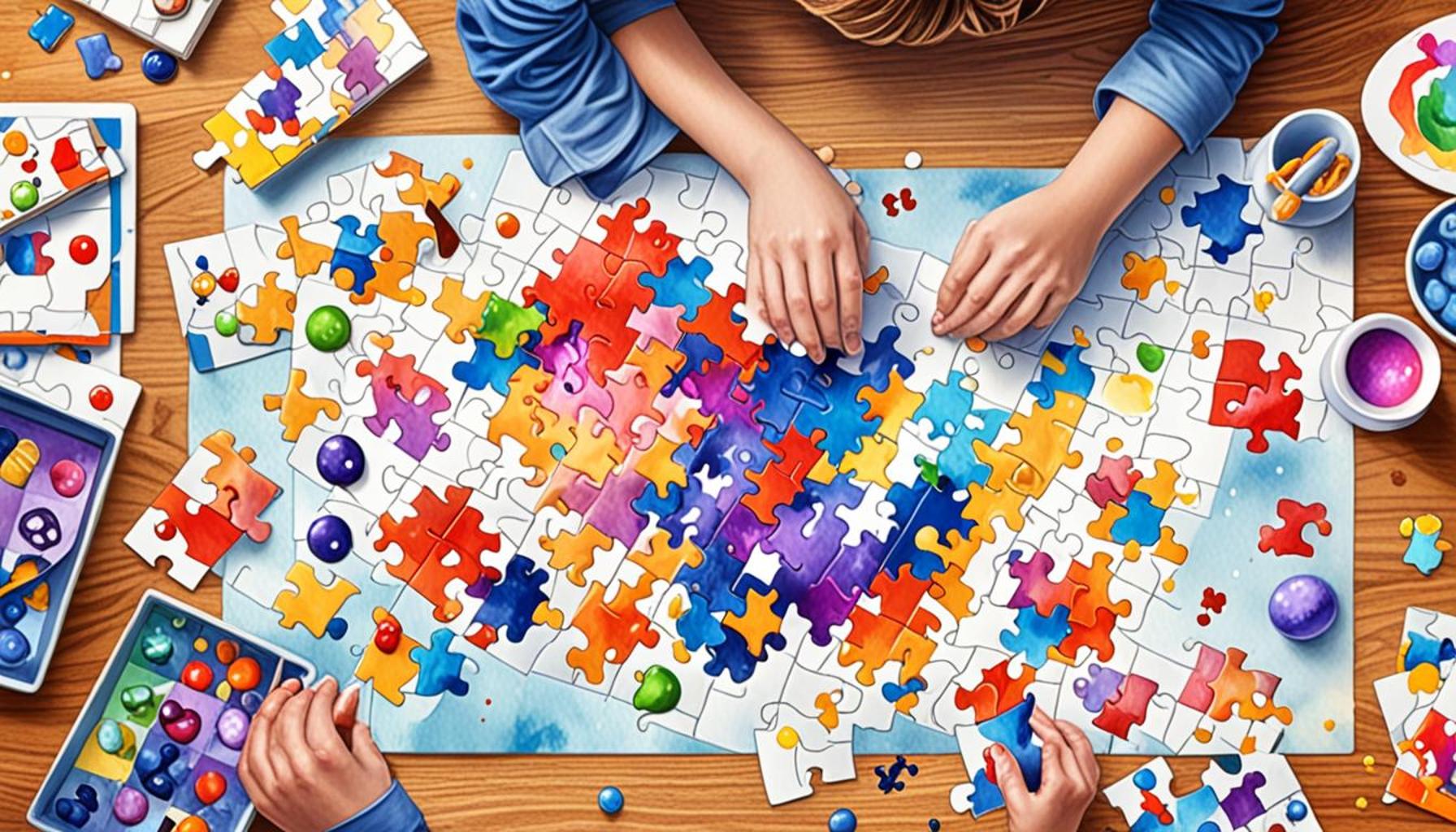
How Mathematical Puzzles Can Boost Memory and Logical Reasoning in Children

Unlocking the Power of Puzzles
In an age where digital distractions are everywhere, the simplicity of mathematical puzzles stands out as a powerful tool for cognitive development. These engaging challenges not only entertain children, but also stimulate their minds, enhancing essential skills like memory and logical reasoning. As technology continues to dominate playtime, the role of traditional puzzles becomes increasingly crucial.
Research shows that children who regularly engage in mathematical puzzles tend to:
- Improve their problem-solving abilities: When faced with a puzzle, children learn to analyze and approach problems methodically, which is vital in both academic settings and real-life situations.
- Enhance their memory retention: Frequent exposure to puzzles encourages the brain to retain various strategies and solutions, effectively strengthening memory pathways.
- Build a stronger foundation in math concepts: From basic arithmetic to advanced problem-solving, these puzzles reinforce mathematical principles in a fun and engaging manner.
Moreover, mathematical puzzles can be easily integrated into daily routines. Parents and educators across the United States have begun to recognize the immense benefits, including:
- Fostering independent thinking: Solving puzzles encourages children to think for themselves, cultivating a sense of autonomy and confidence in their abilities.
- Encouraging perseverance and resilience: Children often encounter frustrating moments with puzzles, teaching them the value of persistence and the ability to bounce back from setbacks.
- Promoting teamwork through group challenges: Engaging in puzzles collaboratively can enhance communication skills and improve social dynamics, making learning a shared experience.
As children tackle puzzles, they develop not just intellectual skills, but also emotional and social ones, making them well-rounded learners. In classrooms across the nation, educators are increasingly implementing puzzles in their lesson plans. For instance, using Sudoku to enhance logical thinking or employing logic grid puzzles to improve deductive reasoning skills presents varied opportunities for creativity in teaching.
Additionally, the rise of online platforms and mobile applications dedicated to math puzzles has made these tools even more accessible. Websites such as Khan Academy and Cool Math offer interactive challenges that keep kids engaged while learning. This article aims to dive deeper into how mathematical puzzles can boost memory and logical reasoning in children, showcasing methods, examples, and research that underscores their importance.
In conclusion, as we navigate an increasingly complex digital landscape, revitalizing interest in mathematical puzzles can play a pivotal role in cultivating the next generation of thinkers and problem solvers. These activities not only provide a break from screens but also equip children with indispensable life skills that extend beyond the classroom.
DISCOVER MORE: Click here to enhance your mental well-being
The Cognitive Benefits of Engaging with Mathematical Puzzles
Mathematical puzzles serve as a unique intersection between entertainment and education, offering children a vibrant platform to cultivate memory and logical reasoning. These immersive experiences not only challenge young minds but also equip them with essential cognitive tools that can aid in their academic pursuits and everyday life. As educators and parents explore effective ways to support children’s intellectual growth, the prominence of mathematical puzzles becomes even more significant.
One of the most remarkable aspects of mathematical puzzles is their ability to enhance problem-solving skills. Children are naturally inquisitive, often approaching tasks with curiosity and creativity. When they encounter a puzzle, they engage in a process of deduction, analysis, and trial and error, ultimately learning to tackle problems from various angles. This practice mirrors real-world challenges and empowers children to think critically, an ability increasingly valued in today’s complex environment.
Moreover, research has shown that regularly solving puzzles can significantly improve memory retention. Engaging with numerical problems encourages children to memorize different strategies and solutions, which in turn strengthens the neural pathways associated with memory. This engagement helps to make the process of learning not just about retention of facts, but also about understanding how to approach and remember an array of problem-solving methods. In addition, children who participate in regular puzzle-solving activities show improved recall abilities, making it easier for them to remember information learned in traditional classroom settings.
The benefits extend beyond intellectual capabilities; mathematical puzzles are also a fantastic way to build a robust foundation in math concepts. By tackling puzzles that emphasize addition, subtraction, and more complex areas like geometry and algebra, children find themselves immersed in the mathematical world. This integration not only makes math enjoyable, but also demystifies concepts that can often appear daunting. As they play, they start to develop a sense of numerical fluency, which translates into confidence in their abilities.
To illustrate the myriad advantages of engaging with mathematical puzzles, here are some key benefits:
- Enhanced critical thinking: Children learn to evaluate the best methods for approaching a problem, honing their analytical skills.
- Increased motivation: The challenge of solving puzzles can ignite a spark of excitement, motivating children to persist and explore more.
- Social interaction and collaboration: Working on puzzles in groups can foster teamwork and improve communication skills among peers.
Furthermore, educational frameworks in the United States have begun to adapt their curricula to incorporate mathematical puzzles as an engaging pedagogical tool. Initiatives from programs like MathCounts and local math clubs are encouraging children to embrace math not just as a subject, but as a fun challenge. In this supportive environment, children have the chance to grow their abilities and develop a love for mathematics that can last a lifetime.
As we explore how mathematical puzzles can bolster children’s skills in memory and logical reasoning, it is clear that the shift back to these interactive and stimulating activities is essential for fostering a generation of thinkers and innovators.
How Mathematical Puzzles Enhance Cognitive Skills
Engaging children with mathematical puzzles serves as a stimulating way to improve their memory and logical reasoning abilities. Unlike traditional forms of learning, puzzles require kids to think critically and creatively. By regularly solving these challenges, children can develop neuroplasticity, meaning that their brains can change and adapt based on new experiences. This is particularly beneficial for young learners as it lays the foundation for both academic success and everyday problem-solving skills.
Memory Retention through Puzzle Solving
Research indicates that when children tackle puzzles, they engage multiple brain regions that are responsible for memory and information processing. As a direct result, these activities reinforce their memory retention capacity. Furthermore, challenges that involve pattern recognition or spatial reasoning can lead to significant improvements in how children store and retrieve information.
Logical Reasoning Development
Logical reasoning is another critical aspect developed through puzzles. As children analyze and breakdown problems to find solutions, they learn to think systematically and make justified decisions. Engaging with mathematical puzzles can teach kids about cause and effect, enhancing their ability to apply logical reasoning in various contexts beyond math.
| Category | Advantages |
|---|---|
| Memory Enhancement | Solving puzzles activates brain areas linked to memory, improving retention and recall. |
| Strengthening Logical Skills | Kids learn to make connections and draw conclusions systematically, fostering an analytical mindset. |
Conclusion
Involving children in mathematical puzzles can pave the way for improved focus and enhanced analytical skills. As they navigate through different types of challenges, their capability to think logically while retaining critical information will grow immensely. This encourages not just academic excellence, but also equips them with lifelong reasoning skills.
DISCOVER MORE: Click here to delve deeper
Engagement through Gamification and Real-World Applications
Another significant aspect of mathematical puzzles is their potential for gamification, which enhances children’s engagement and motivation. By turning mathematical concepts into games, educators can present challenges that feel less like traditional homework and more like enjoyable pastimes. For instance, interactive platforms that feature mathematical video games and online puzzle-solving competitions effectively capture children’s attention. This approach has proven particularly effective in the United States, where initiatives such as STEM (Science, Technology, Engineering, and Mathematics) programs are integrated into schools to promote a stronger affinity for mathematical disciplines.
Games that require children to solve variations of classical puzzles—such as Sudoku, tangrams, or even mathematical scavenger hunts—help in developing their logical reasoning. In these scenarios, children must analyze clues, strategize their moves, and make decisions based on mathematical principles. For example, a puzzle that necessitates solving a series of equations to advance in a game can reinforce both problem-solving and memory skills, as children must remember previous solutions while applying them to new challenges.
An important dimension lies in the real-world applications of mathematical puzzles, which can demonstrate the tangible benefits of mathematical proficiency. When children see how puzzles relate to everyday situations—such as budgeting for a school project, planning a family trip using geometry, or even programming a simple video game—they begin to appreciate the importance of mathematics in daily life. This recognition fosters a deeper understanding of mathematical concepts and enhances their critical thinking skills.
Additionally, mathematical puzzles can weave in interdisciplinary connections. For instance, a project that combines math with art—like designing fractal patterns or exploring symmetry through geometric shapes—encourages creative thinking while still maintaining a strong mathematical framework. When children experience the convergence of math with art, science, or technology, it fosters a holistic approach to learning that can strongly impact how they engage with mathematics.
Statistics provide further insight into the powerful correlations between puzzle-solving and cognitive development. Research suggests that children who regularly engage with mathematical puzzles display an average of 30% higher problem-solving abilities compared to those who do not. This evidence showcases the potential for puzzles not only to enhance academic performance but also to equip children with skills that are essential for future employment—such as analytical thinking and decision-making.
Moreover, the social dimension cannot be overlooked. Collaborative puzzles in classroom settings or competition-based events can improve communication skills and peer relationships. Children learn to articulate their thought processes and defend their solution approaches, which can lead to a greater sense of community and support among their classmates. The ability to work effectively in teams is a critical skill that carries significant weight in both academic and professional environments.
In summary, the multifaceted benefits of integrating mathematical puzzles into children’s learning experiences go far beyond mere entertainment. By enhancing memory, logical reasoning, and problem-solving skills while fostering creativity and collaboration, these puzzles are standing out as vital tools in developing the future generation’s mathematical prowess.
DIVE DEEPER: Click here to discover more
Conclusion: Unleashing the Power of Mathematical Puzzles
In conclusion, the exploration of mathematical puzzles reveals their profound capacity to enhance not only children’s memory and logical reasoning but also their overall cognitive development. By embedding engaging challenges into their learning journeys, we can make mathematics a source of excitement rather than a chore. Puzzle-solving serves as a stimulating avenue for developing essential skills such as problem-solving, analytical thinking, and resilience—traits that are increasingly vital in today’s complex world.
Furthermore, the appeal of gamification and its intersection with real-world applications create an engaging learning environment where children can see the practical uses of math. When educators leverage puzzles across various disciplines, they cultivate interdisciplinary connections that keep students motivated and curious. This multifaceted approach encourages children to think critically and apply their knowledge to diverse contexts, thereby reinforcing their understanding of mathematical concepts.
Statistics suggesting that children who engage regularly with mathematical puzzles exhibit a 30% increase in their problem-solving abilities are not merely numbers; they underscore the potential these activities have in shaping the intellectual landscape of the next generation. As we advocate for the inclusion of puzzles in educational curricula, we encourage parents, educators, and policymakers alike to recognize their value not just for enhancing academic performance but for nurturing well-rounded, confident individuals ready to face future challenges.
As we continue to prioritize creative and effective education strategies, the role of mathematical puzzles must not be overlooked. They stand as powerful tools in unlocking children’s full potential, ensuring they are well-equipped for both academic success and lifelong learning. The journey of mathematical exploration through puzzles is as much about the journey as it is about the destination—a lesson that resonates with both young and old alike.