What distance should one square stand for on an RPG map?
- By
- expenseforge.com
- Published
- Reading time
- 6 min
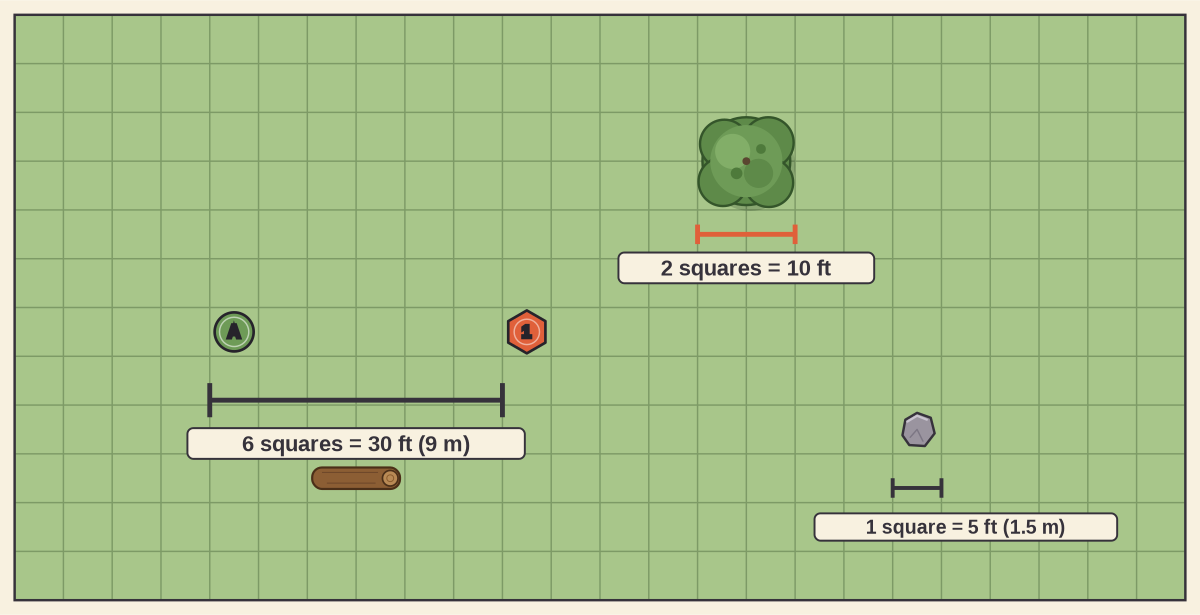
A table is drawn two squares long, and the door beside it somehow takes up three. The map looks fine until a figure tries to walk across it and nobody can agree how far anything is. The cause is almost always a scale that quietly changed halfway through the drawing.
This guide explains what one square can stand for, how to choose between 5 ft (1.5 m), 10 ft and 1 m, when a change of scale is the right move, and how to keep a single scale honest from the first wall to the last label.
What one square actually promises
A square is a unit of distance, and everything on the map is measured in it: how far a figure walks, how wide a corridor is, how big a room feels. Once you set the scale, each piece you place makes a claim about real size. A scale only works when those claims agree with each other.
The four scales in the table cover almost every scene. Imperial and metric values are close but not identical: 5 ft is about 1.52 m, so 1.5 m per square is a rounded version of the same grid.
| Scale per square | Close equivalent | Best for |
|---|---|---|
| 5 ft | 1.5 m | Rooms, corridors, most interiors |
| 1.5 m | 5 ft | The same scenes, with metric labels |
| 10 ft | 3 m | Large halls, courtyards, small outdoor areas |
| 1 m | about 3.3 ft | Cramped interiors where furniture detail matters |
Think of a square as a unit for counting, not a claim that a figure fills the whole floor patch. It reserves the figure's own space plus elbow room around it, which is why the square is larger than the piece standing in it.
Pick one pair of units for your table and stick with it. Writing the scale once in both units, such as 5 ft (1.5 m), helps every player follow the same numbers.
Choose the scale from the smallest thing that matters
Look at the smallest feature that must stay visible, such as a chair, a door or a barrel. If it is much smaller than a square, it will either vanish or be drawn out of proportion. The smaller that feature is, the less distance each square should stand for.
Interiors usually work at 5 ft (1.5 m). Very small rooms sometimes need 1 m, because a cottage that is 6 m by 5 m becomes a grid of 6 by 5 at 1 m but only about 4 by 3 at 1.5 m. Open ground goes the other way: a field 300 ft (90 m) wide takes 60 squares at 5 ft and only 30 at 10 ft.
Decide by asking which scene you are running. A fight in a hall wants tidy room for movement. A search of a bedroom wants furniture you can look at.
Test doors and furniture against the scale
Real objects have fixed sizes, so they work as rulers. A door opening is about 3 ft (0.9 m) wide, which is less than one square at 5 ft (1.5 m). In practice you draw it as one full square edge and accept the small exaggeration, because a figure must be able to pass through.
| Item | Real size | At 5 ft (1.5 m) | At 1 m |
|---|---|---|---|
| Door opening | 3 ft (0.9 m) wide | One square edge | One square edge |
| Single bed | 3 by 6.5 ft (0.9 by 2 m) | 1 by 1 square | 1 by 2 squares |
| Table for four | 3 by 5 ft (0.9 by 1.5 m) | 1 square | 1 by 2 squares |
| Barrel | 2 ft (0.6 m) across | Under half a square | A little over half a square |
When the real size is smaller than one square, draw the piece at its true proportion inside the square instead of stretching it to fill it. A barrel at half a square tells the eye the scale is honest, while a barrel as big as a bed tells it the map is lying.
Stairs make a second ruler. A flight that climbs one storey of about 9 ft (2.7 m) needs a run of roughly 12 to 14 ft (3.7 to 4.3 m), which is 2 to 3 squares at 5 ft. Drawn only one square long, the same stair reads as a ladder or a steep ramp, so check its length against the scale before you place it.
Change scale on purpose, never by accident
Scale is allowed to change between maps. It should not change inside one. A journey across a valley wants 10 ft squares, and the cabin at the end of it wants 1 m squares. Draw them as two maps, and write the scale on each.
If one drawing truly needs two zoom levels, add an inset with its own scale bar, and mark it clearly so nobody counts squares across the boundary. A scale bar is a short line labeled with a length, such as two squares marked 10 ft (3 m).
Changing the scale also changes movement in squares. A figure that moves 30 ft (9 m) in a turn crosses 6 squares at 5 ft, only 3 squares at 10 ft and 9 squares at 1 m. Decide at the start of the session whether you are keeping distance or keeping square counts, and write the answer on a card. Measuring distance on grid maps covers how to count them without arguments.
Keep one scale from the first wall to the last label
Choose the scale when you create the grid, not after you have placed twenty pieces. In the Map Builder the scale per square is set with the grid, using 5 ft, 10 ft, 1.5 m or 1 m, and every piece snaps to that grid. That removes the main way scales drift: pieces drawn by eye.
Scale in the game is separate from print size. The scale per square is a distance in the story, while the printed size of a square is a physical length on paper, which printing at true scale covers. Both can change independently without breaking the map.
Check the finished drawing with a short pass:
- A door is one square wide everywhere on the map.
- Corridors are a whole number of squares wide, and the widths are intended. Corridor width and chokepoints explains why they matter.
- The scale appears on the map in both units.
- Furniture is no larger than the real object would be at that scale.
- The grid size still fits the scene, as in choosing a grid size.
Common mistakes
- Mixing scales on one map. A courtyard at 10 ft per square beside a kitchen at 5 ft per square makes every distance meaningless. Split them into two maps or redraw one part.
- Using 10 ft squares for interiors. A table shrinks to a speck and doors lose meaning. Use 5 ft (1.5 m) or 1 m for rooms.
- Using tiny squares for open ground. A field at 1 m per square runs off any sheet. Switch to 10 ft or split the area.
- Leaving the scale unwritten. Players guess, and each guess differs. Put a scale bar or a short note in a corner.
- Mixing units mid-session. One person counts feet and another counts metres. Pick one pair, and write both once.
FAQ
Is 5 ft per square the same as 1.5 m per square?
In play, yes. A foot is a little over 30 cm, so 5 ft is about 1.52 m. The difference is 2 cm per square, which no table will notice. Choose whichever label your group prefers and keep it on every map you make.
Which scale suits an outdoor map?
Use 10 ft (3 m) squares for small areas such as a camp or crossing, and consider separate maps for larger ground. Keep 5 ft (1.5 m) when figures need cover and tight positions, since trees and boulders at 10 ft squares can look too far apart.
Does changing the scale change how fast figures move?
It changes how many squares they move, not how far. A figure that moves 30 ft (9 m) covers 6 squares at 5 ft but only 3 at 10 ft. Write the rule on a card before play so nobody has to work it out mid-scene.
Sources
- Robinson, Arthur H., et al. Elements of Cartography. 6th ed. John Wiley & Sons, 1995. For how map scale and scale bars are explained in cartography.
- Ching, Francis D. K. Architecture: Form, Space, and Order. 4th ed. John Wiley & Sons, 2014. For human proportion and the sizes of everyday building elements.
- Totten, Christopher W. An Architectural Approach to Level Design. 2nd ed. CRC Press, 2019. For how space sizes are chosen to suit what happens in them.