Square, hex or gridless: which map style fits your scene?
- By
- expenseforge.com
- Published
- Reading time
- 6 min
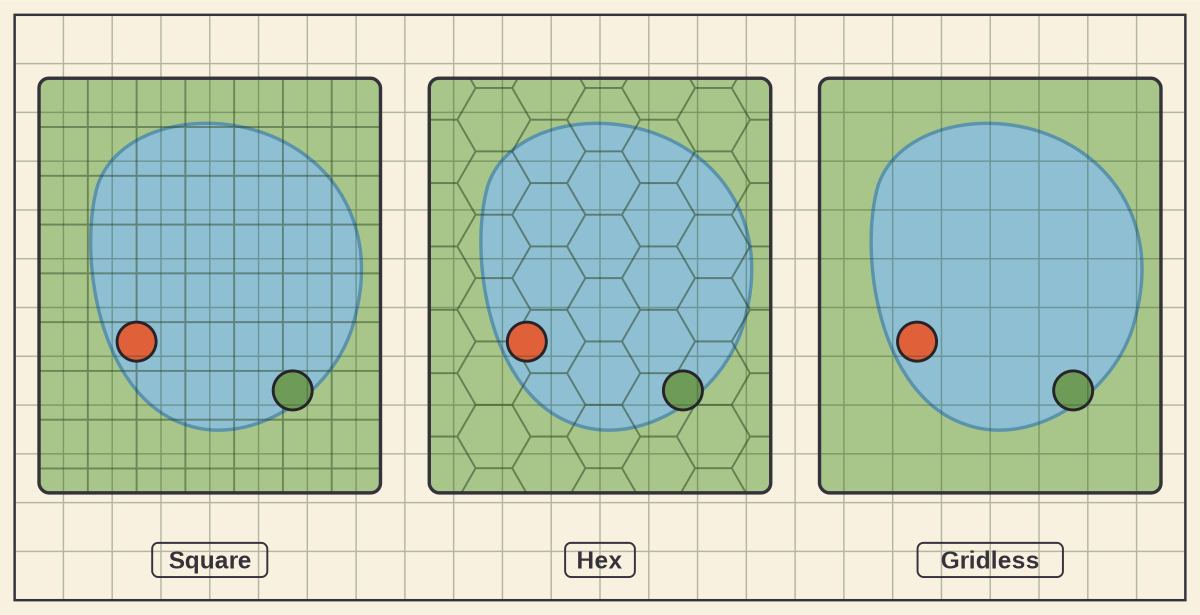
You are about to start a new map, and the first decision has nothing to do with walls or trees: should it have a grid at all, and if so, what shape? Pick wrongly and the movement rules fight the map, or the map fights the table.
This guide compares square grids, hex grids and gridless maps on four points: how distance is counted, how well each handles buildings and open ground, how much drawing each one needs and how it prints. You will end with a simple rule for choosing.
How each type counts distance
On a square grid a figure has eight neighbors: four share an edge, four touch only at a corner. The corner neighbors sit about 1.41 times as far away as the edge neighbors, which is the diagonal problem that measuring distance on grid maps explains.
A hex grid has six neighbors, and every one of them sits at the same distance. A step in any direction is one hex, and counting is as simple as it gets. Moving 5 hexes means exactly 5 steps whichever way you head.
A gridless map has no cells at all. You measure with a ruler, a length of string or a marked card, which gives precise distances in any direction and slows down every measurement.
| Feature | Square grid | Hex grid | Gridless |
|---|---|---|---|
| Neighbors of a position | 8, at two different distances | 6, all at one distance | Any direction |
| Diagonal problem | Yes, needs a rule | No | No |
| Counting method | Count squares | Count hexes | Measure with a tool |
| Tool needed | None | None | Ruler or string |
The count tells you how much thinking each decision takes. Hex has the least arithmetic, square has a little more and gridless has the most, though it also gives the most freedom of position.
Square grids suit buildings and rooms
Most walls, doors and furniture have straight edges that meet at right angles, and a square grid matches them exactly. A wall runs along a grid line, a door fills one square edge and a corridor is a whole number of squares wide. Pieces line up without tricks, which is why square grids dominate interior maps.
Square grids also print and tile easily. Squares fill a rectangle with no gaps or odd shapes at the edges, so joining sheets stays simple, as in tiling a large map over several pages. Graph paper exists everywhere, and reading a square grid needs no explanation for new players.
The weaknesses are diagonal movement and area shapes. A reach of 3 squares forms a block unless the table agrees a different rule. You can live with these weaknesses indoors, because corridors and rooms limit movement to straight lines anyway.
The Map Builder draws square grids only, from 6 to 60 columns and rows. That fits interiors and small outdoor scenes well, but it does not make hex maps.
Hex grids suit open ground and travel
Natural ground has no preferred direction, and a hex grid does not either. A river bend, a hill range or a forest edge fits against hexes with fewer awkward steps than against squares, and movement across them feels even in every direction.
Hexes shine when each cell can hold a single idea, such as one kind of terrain. A hex can stand for a mile (1.6 km) on a journey map or 10 ft (3 m) in a skirmish across a field. The size is yours, but one hex should always hold one clear kind of ground, so a reader can tell what lies in it.
The weakness is buildings. A hex has no right angles, so a rectangular room fits badly, and a door or a straight wall has to zigzag along the cell edges. Printing is less convenient too, because hex sheets come in two orientations, and the one that matches the sheet edges is not always the one you want.
A hex measured 1 in (25 mm) across its flat sides covers a little under one square inch, about 0.87 of it. That is close enough that a figure on either grid has similar elbow room.
Gridless maps suit talk and quick sketches
Some scenes do not need a grid. A negotiation, a festival crowd or a chase along a road is about relationships and direction, not counting. A gridless sketch is quick, flexible and often prettier to look at.
Precision comes from agreement. Choose a ruler distance for a unit, such as 1 in for 5 ft (1.5 m), so a 30 ft (9 m) move equals 6 in (15 cm). Mark it on a strip of card and keep the strip on the table. Without that, every position becomes a negotiation.
Another option is range bands. Draw three loose zones around a point and call them close, near and far. Figures inside the same zone can reach one another, and figures in different zones cannot. The map then answers questions about who is where without measurement.
Add a scale bar to every gridless map, since there are no squares to give the size away. Setting the distance per square covers the same ideas in a grid setting.
Choose by scene, not by habit
Use this order of questions, and stop at the first yes.
- Does the scene have walls, rooms or furniture? Use a square grid.
- Does it cover open ground or a long route? Use a hex grid, or split the journey into steps on a hex sheet.
- Is it mostly conversation or a loose sketch? Go gridless, with a scale bar and a measuring strip.
- Does it need all three? Use separate maps and connect them, as the example above does.
A campaign can mix all three, as long as each map keeps one grid. A group might use hex sheets for journeys, square maps for every building and loose sketches for talks. What matters is that players can tell at a glance which counting method applies to the sheet in front of them.
Think about printing as well. Square grids at fixed sizes are the simplest route to a printed map that matches your table, which a guide to printing squares at fixed sizes walks through. For overland scenes, trails and roads on maps shows how paths read on whichever grid you choose.
Common mistakes
- Drawing a building on a hex grid. Walls zigzag and rooms look ragged. Use squares for interiors.
- Using squares for a long journey. Counting hundreds of squares is slow. Use hexes, or a gridless route map.
- Going gridless without a measuring tool. Each player guesses a different distance. Keep a marked strip or a ruler at the table.
- Mixing grid types inside one scene. Two grids on one sheet produce conflicting counts. Give each type its own map.
- Skipping the scale on gridless maps. Without squares nothing shows the size. Add a scale bar and state it once.
FAQ
Is a hex grid better than a square grid?
It is better for counting distance in open ground, because every neighbor is the same distance away. It is worse for buildings, because rooms and corridors are built from right angles. Neither is better overall. Choose by the kind of scene you run most.
Can the Map Builder draw hex maps?
No. The Map Builder uses a square grid with 6 to 60 columns and rows. For a hex map, use hex paper or another tool. You can still draw interiors and small outdoor scenes in the Map Builder and keep hex sheets for travel.
How do ranges work without a grid?
Use a ruler or a marked strip, with a fixed length for each unit of distance, or use loose zones such as close, near and far. Agree on the method before play. The map then supports the conversation instead of starting an argument.
Sources
- Schell, Jesse. The Art of Game Design: A Book of Lenses. 3rd ed. CRC Press, 2019. For how the shape of a game space and its rules shape play.
- Kremers, Rudolf. Level Design: Concept, Theory, and Practice. A K Peters, 2009. For how level space supports the movement a design intends.
- Salen, Katie, and Eric Zimmerman. Rules of Play: Game Design Fundamentals. MIT Press, 2003. For how rules and space fit together as one structure.
- Robinson, Arthur H., et al. Elements of Cartography. 6th ed. John Wiley & Sons, 1995. For how reference grids and scales help readers measure on a map.