Secret doors and hidden passages: how to hide a way through fairly
- By
- expenseforge.com
- Published
- Reading time
- 6 min
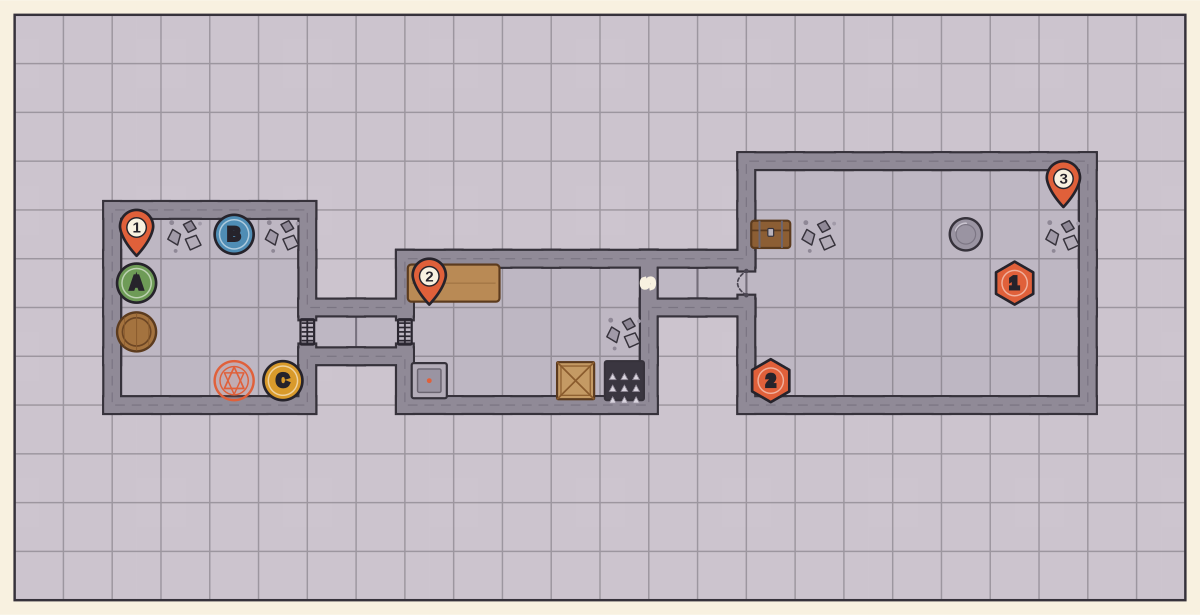
A secret door has a built-in problem. The map shows a wall, and the group is asked to see through it. If nothing points at that wall, the secret becomes a blind search, and the table spends several minutes tapping every surface. If too much points at it, there is no secret left.
This guide shows how to build a hidden passage whose clues are already on the map: odd wall thickness, missing space, a draft, a scuffed floor. You will learn where secrets fit, how to draw them on two copies of the map, and how many to include in one dungeon.
A secret is a promise the map already made
A fair secret can be worked out. Somewhere on the map, or in the description of a room, there is a detail that does not add up, and a careful group can notice it and ask why. The discovery then feels like a deduction, not like luck.
Test every secret with one question: could a group predict this from the map alone? If the answer is no, add a clue or remove the secret.
Three kinds of concealed route deserve to be told apart, because each one needs a different clue.
| Type | What is hidden | A typical clue | A good role |
|---|---|---|---|
| Secret door | The door in a wall | A gap between two rooms | A shortcut or a bypass |
| Hidden passage | A corridor with a concealed entrance | A draft or a sound | A link between two zones |
| Hidden room | A whole space | Squares missing from the plan | An optional side scene |
A secret that arrives with no hint breaks the unspoken agreement between the map and the group, and the table notices. A secret door is the smallest of the three and the easiest to place. A hidden room is the largest, and it needs the strongest clue, because the group is looking for a space instead of a door.
Where a hidden passage can sit
Look at your map for places where something is already off. Four spots work well.
- A wall that is too thick. Most interior walls are 1 square wide. If two rooms sit 3 squares apart, 2 squares of that wall have a purpose. At 5 ft (1.5 m) per square, that is 10 ft (3 m) of solid stone that a careful group can question.
- Mismatched dimensions. A room measures 10 squares wide inside, but the outer walls of the building span 14 squares at that point. The missing 4 squares are the clue.
- A broken pattern. A hall has a niche on its left wall but none on the right. The odd one out invites a second look.
- A passage that stops. A corridor ends at a plain wall with no door and no reason. This is the oldest clue, so use it sparingly. The guide on loops, shortcuts and dead ends explains when a real dead end is better.
Pick a spot first and place the secret afterward. A secret that sits in a wall with no reason to exist is a patch, not a design.
Clues the group can actually use
Plant clues in more than one form, so a group that misses one can catch another.
- On the map: the missing squares, the thick wall, the broken pattern.
- On the floor: a scuffed arc where a door has swung, a worn line across the paving, a smudge on one stone.
- In the air and sound: a draft that bends a flame, a hollow echo when someone speaks near one wall, a faint hum.
- In use: a table pushed to one side of a wall more than the room needs, a rug with a worn edge.
Aim for two clues in different forms for every secret, and place at least one before the group reaches the wall. A clue seen in the previous room works well: a scuff on the floor of room A can point to a passage in room B.
Say the clue in your own words with the details of the room. How to phrase it, and how much to point, is covered in describing maps aloud.
Drawing secret doors on two copies of the map
You need a version for yourself that shows the secret and a version for the players that does not. In the Map Builder, the steps are short:
- Build the map and mark the hidden passage with the secret door piece, which looks like a stretch of wall with a small S on it.
- Save the map and download the file as your own copy.
- For the player copy, select the secret door piece, delete it and draw an ordinary wall segment in its place with the wall brush, so the wall reads as solid. Add a text label to your own copy to mark the clue.
- Export the player copy as PNG or PDF and check that the secret is not visible.
- When the group finds the door, replace the wall segment with a door piece, or use the cover methods in revealing maps during play.
Locking the Walls layer keeps you from moving a piece by accident while you edit the rest of the map. Pieces snap to the edges of the grid squares, so a door that you add later lands on the same wall edge as the secret door on your own copy.
How many secrets, and what sits behind them
One secret in every six to eight rooms is a good starting point. A dungeon with a secret behind every other wall teaches the group to search constantly, and the real secrets lose meaning.
What lies behind a secret matters more than how well it is hidden. A good choice is an alternative: a shortcut, a bypass around a hard room, a view over a scene before it starts. Avoid hiding the only way forward. If the group cannot find it, the session stops.
- The secret can be worked out from the map or the description.
- Two clues in different forms point to it.
- At least one clue appears before the group reaches the wall.
- The secret never blocks the only way forward.
- The player copy has been exported and checked.
Common mistakes
- A secret on the only path. If the group cannot find it, the session stalls. Always offer another route.
- No clue at all. A blank wall with a hidden door is a blind search. Add one clue on the map and one in the description.
- Too many clues. Three pointers in one room make the secret obvious. Two clues in different forms are enough.
- The secret left on the player copy. A door drawn on the version players see is spoiled. Check the exported file.
- Every dead end hides a door. The group learns to search each stub and the pattern loses its force. Keep some dead ends plain.
FAQ
How do you hide a secret door on a printed map?
Draw the wall as solid on the player copy and keep the door only on your own copy. Export two files, one for each version, and check the player file before printing. If you want to show the door later, add a small label or a sticker over the wall.
How many secret doors should a dungeon have?
Start with one for every six to eight rooms. A short dungeon of six rooms can hold one. A larger dungeon of twenty rooms can hold two or three, spread far apart so the group does not start searching every wall. Place each as a shortcut or a bypass, and make sure the map can be finished without them.
What should lie behind a hidden passage?
Something that changes how the group moves: a shortcut, a way around a room, a view from above, or a side scene. Keep the content optional. A hidden passage that leads to the main goal turns a fair puzzle into a gate that stops the session.
How can players find a secret without searching every wall?
Give them a reason to look at one wall. A draft, a mismatch in size or a scuffed floor narrows the search to a few squares. Describe the clue plainly, repeat it if the group seems to miss it, and let the players connect it to the map themselves.
Sources
- Schell, Jesse. The Art of Game Design: A Book of Lenses. 3rd ed. CRC Press, 2019. For general lenses on surprise, fairness and how players read hints.
- Norman, Donald A. The Design of Everyday Things. Revised and expanded ed. Basic Books, 2013. For how visible signals tell people what a place or object can do.
- Totten, Christopher W. An Architectural Approach to Level Design. 2nd ed. CRC Press, 2019. For how plans, wall thickness and room proportions work as architecture.
- Monmonier, Mark. How to Lie with Maps. 3rd ed. University of Chicago Press, 2018. For how maps choose what to show and what to leave out.
- Kremers, Rudolf. Level Design: Concept, Theory, and Practice. A K Peters, 2009. For level design thinking about secrets, shortcuts and optional areas.
Also in Dungeons
- B1Dungeon room flow: hubs, branches, sequences
- B2Dungeon loops, shortcuts and dead ends
- B3Dungeon door placement and door types
- B4Readable dungeon traps that feel fair
- B6Corridor width and chokepoints
- B7Dungeon room sizes in squares
- B8Multi-level dungeon maps on flat paper
- B9Ruins and collapsed halls on a map