How to describe a map out loud so players can picture it
- By
- expenseforge.com
- Published
- Reading time
- 6 min
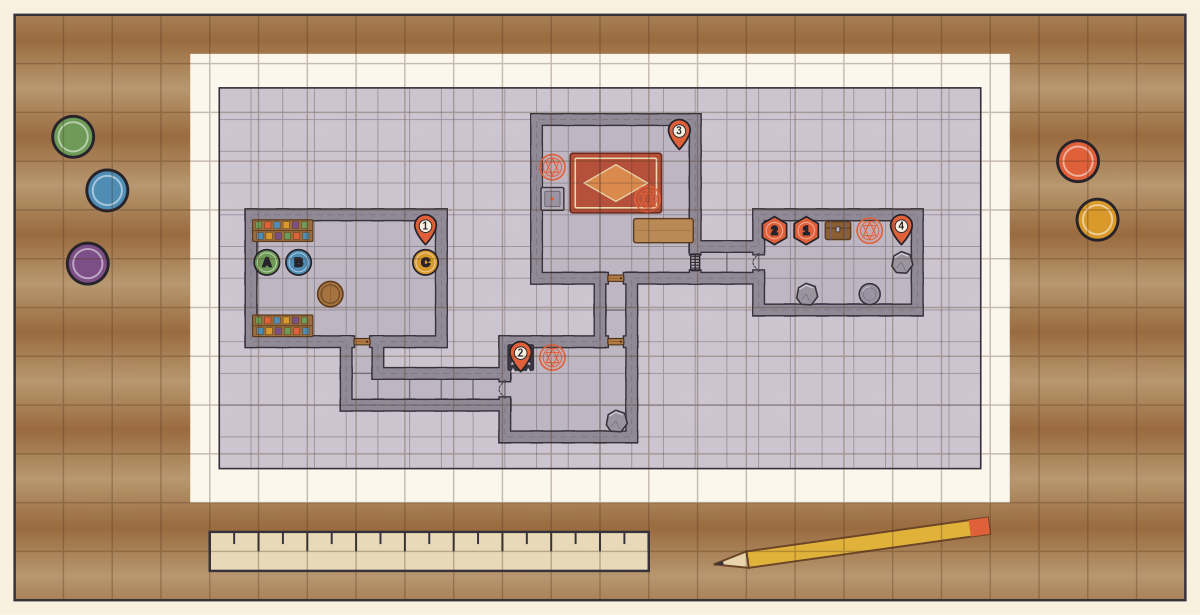
A description that wanders loses the table. Players hear "a large room with pillars, a fireplace, some doors and a table", and five different pictures form, none matching the map. The words and the drawing have to agree, and the words need an order a listener can follow without effort.
The sections below give a fixed order for descriptions, show how a landmark and a few numbers keep everyone picturing the same space, and explain what to say out loud and what to leave to the drawing on the table.
Describe in a fixed order: shape, features, exits
A listener builds a picture from large things to small ones. Give them the big form first and the details after, in the same order every time, so players learn what to expect.
Start by saying where the party stands: "You are in the south doorway." Everything that follows is measured from that point. Then use five steps.
| Step | What to say | Example |
|---|---|---|
| Viewpoint | Where the party stands | "You stand in the south doorway." |
| Shape and size | Overall form in squares | "A hall 6 squares wide and 10 long, 30 by 50 ft (9 by 15 m)." |
| Dominant feature | The one thing that stands out | "A long stone table fills the middle." |
| Other features | Two or three more, in one sweep | "Shelves on the left wall, a hearth at the far end." |
| Exits | Doors and passages | "A door on the right wall, two squares in." |
Keep each step to one sentence. The pause between steps gives players time to look at the drawing and match your words to the squares. When a room is simple, skip a step that has nothing to say, but never change the order.
Give numbers before names. "A hall ten squares long" sets the scale before the first object is placed, and every later feature is then judged against it.
Finish with one sensory line at most, such as a sound or a smell. Too many details at the start crowd out the layout, and the layout is what players need to act.
Anchor the picture with a landmark and numbers
Everyone needs a fixed point to measure from. Give them a landmark: a feature large enough to see from anywhere in the room, such as a hearth, a well or a great oak. The landmark you name should be the same thing the eye lands on in the drawing, a point covered in focal points on a map. Once it is named, every other feature can be placed relative to it. "The door is two squares left of the hearth" is easier to hold in the mind than a list of positions around a room.
A grid gives you a second tool: counting. When the map is on the table, say distances in squares, because players can check them by eye. "Four squares ahead" is easier to follow than "about 20 ft (6 m) ahead". When the map is not on the table, say feet and meters instead, because nobody can count squares that are not there.
Compass words or clock positions work well from the entrance. "At your two o'clock" and "on the left wall" both fix a spot without the speaker pointing. Names help as well. A numbered pin or a text label in the Map Builder gives each space a short name you can say aloud, and a consistent set of symbols and legends makes the drawing match your words.
Let the map carry the shapes and your voice carry the rest
A map shows geometry: where walls stand, how large a space is, where the doors are. Speech is slower and less exact at geometry, but strong at everything a drawing leaves out. Divide the work.
Say aloud what the map cannot show:
- Sound, smell, temperature and light.
- Materials and age: worn steps, damp stone, new timber.
- What a character would notice first.
- Movement: a draft, a flicker, a distant noise.
Do not read out what the player can see on the paper. Pointing at the map and saying "the table" repeats the drawing. Saying "the table has been scrubbed clean, and it is the only thing in the room that is" adds something.
When no map is on the table, describe fewer things and repeat the key positions. Three features, each anchored to the landmark, are easier to hold than ten.
Describe a place in the order a person would move through it
People tend to recall places as routes. They turn at an object, walk along a wall and arrive at a door. A description that follows the route the characters will take feels natural, and the way rooms connect in a dungeon often decides what that route is.
Use this sequence for a path or a corridor:
- Say where the party starts and which way they face.
- Give the length of the next stretch in squares.
- Name each turn or junction, with the direction and a landmark.
- End at the next decision: a door, a split or an open space.
For example: "From the gate, a path runs straight for 8 squares, 40 ft (12 m), then splits at a large oak. Left leads to the river, right to a low stone wall." The listener now holds a route with a start, a distance, a landmark and a choice.
Outdoor scenes work the same way: begin with the ground under the party's feet, move outward to the nearest landmark, and finish at the horizon or the edge of the map.
Check that the table pictured the same place
Description is only done when the listeners hold the same picture. A quick check takes ten seconds and saves a long argument later.
Ask a question that needs the layout to answer: "Which way is the nearest exit from where you stand?" If two players point in different directions, the description failed and needs a second pass. Repeat it in different words, starting from the landmark.
Give each place a short name the first time you describe it and keep using that name: "the stair room", "the long hall". Players pick up the name and use it to refer to the place, so a move from "the hall" to "the big room" to "the chamber" breaks the thread.
Prepare before the session. Write a card for each map with three lines: shape and size in squares, dominant feature, and exits.
- Viewpoint is stated.
- Shape and size are given in squares.
- One landmark is named.
- Exits are listed with a distance.
- A short name is chosen for each space.
Common mistakes
- Listing everything. Ten features in a row blur together. Give the shape, one dominant feature and two or three more.
- Switching viewpoints. Starting at the door, jumping to the far wall and back loses listeners. Pick a viewpoint and keep to it.
- Mixing units. Squares in one sentence and feet in the next leaves players converting. Choose one for the table.
- Reading out what the map shows. The drawing already shows the table. Add the sound, the smell or the wear.
- Renaming places. Calling one room three names makes players think there are three rooms.
FAQ
How long should a room description be?
Three to five sentences usually cover a room: viewpoint, shape and size, a dominant feature, a few more details and the exits. Longer descriptions are fine for a place that matters to the story, but the more you say, the less each detail sticks, so keep the rest for questions.
Should a description be read from notes?
Short notes help. Write a card with three lines for each map: shape, main feature and exits. Reading a long block of prose aloud flattens the voice, while speaking from a few prompts keeps your eyes on the table and lets you answer questions as they arise.
How can a map be described to someone who cannot see it?
Use the grid. Say the size in squares, give the position of each feature as a count from a landmark, and name the exits with distances. A player who can count squares can build the layout in their head, and a text label on each space gives them a reference to use.
What if players still misunderstand the layout?
Describe it again from the landmark, in different words, and point at the map where possible. If confusion persists, a quick sketch on scrap paper beside the printed map can clear it. Then adjust the next description so the landmark comes earlier.
Sources
- Lynch, Kevin. The Image of the City. MIT Press, 1960. For the idea that landmarks, paths and edges help people hold a place in mind.
- Passini, Romedi. Wayfinding in Architecture. Van Nostrand Reinhold, 1984. For how people navigate and remember routes through buildings.
- MacEachren, Alan M. How Maps Work: Representation, Visualization, and Design. Guilford Press, 1995. For how maps and spoken words work together to carry information.