Paper tokens, standees and loose furniture for a printed map
- By
- expenseforge.com
- Published
- Reading time
- 6 min
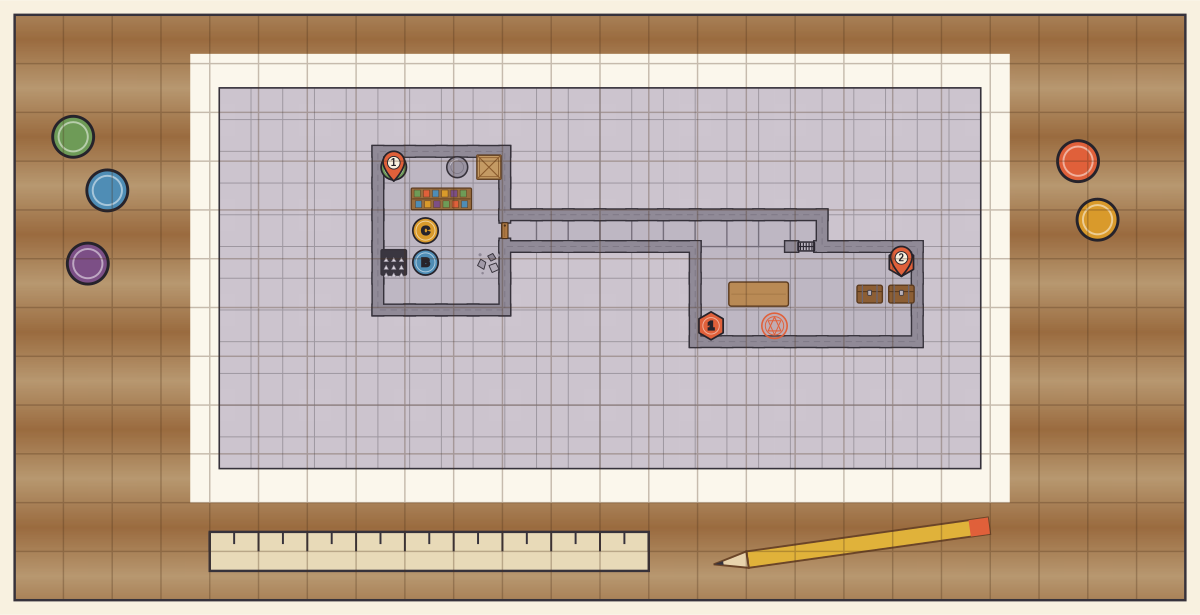
A printed map holds still, but a scene does not. Doors get blocked, a table is pushed against a doorway, and a group of figures needs more room than the plan showed. Pieces that sit on the map instead of being printed into it solve this, and paper makes them quick to produce.
What follows covers how big to cut each piece, how to build a flat token or an upright standee from paper and card, how to treat loose furniture, and how to sort everything so a piece can be found in the middle of a scene.
Size every piece to the grid
Cut each piece a little smaller than the space it stands for. A piece cut to the full square touches the lines and is hard to set down neatly. A common rule is footprint minus 1/8 in (3 mm) in each direction, which leaves a thin gap all round.
Pieces smaller than a square need a second rule. Two creatures of 3/8 in (10 mm) can share one 1 in square and still leave a gap between them. Pieces larger than a square take their full block, such as 2 by 2 squares, and nothing else enters it.
The table assumes squares of 1 in (25 mm), each standing for 5 ft (1.5 m) of game space.
| Piece | Footprint in squares | Cut size | Game distance |
|---|---|---|---|
| Small creature sharing a square | 1/2 by 1/2 | 3/8 in (10 mm) | 2.5 ft (0.75 m) |
| Medium figure | 1 by 1 | 7/8 in (22 mm) | 5 ft (1.5 m) |
| Large creature | 2 by 2 | 1 7/8 in (48 mm) | 10 ft (3 m) |
| Long table | 3 by 1 | 2 7/8 by 7/8 in (73 by 22 mm) | 15 by 5 ft (4.5 by 1.5 m) |
| Bench | 2 by 1/2 | 1 7/8 by 3/8 in (48 by 10 mm) | 10 by 2.5 ft (3 by 0.75 m) |
Pieces only fit when they were made for the same square size as the map. A token cut for 1 in squares looks oversized on a map printed at 3/4 in, so settle the print size first, as described in printing at true scale.
Build a flat token
A flat token is the simplest piece and the hardest to lose track of. Print the art, glue it to card and cut it out. A square token lines up with the grid more easily than a round one, and square corners are quick to cut.
- Print a sheet of pieces at the same square size as the map.
- Glue the sheet to stiff card with a thin layer of glue stick, working from the center outward to avoid wrinkles.
- Cut along the guide lines with a ruler and a sharp blade or scissors.
- Round the corners slightly so they do not catch on the map.
- Write a letter or number on the top edge of each token, on the side the players see.
Use the back for information. A clean face on the front and a status symbol on the back lets you flip a token without finding a second piece, a method expanded in markers for position and status.
You can lay out a whole sheet of pieces in the Map Builder: place hero, creature and NPC tokens, duplicate them, and export at the same print scale as your table map. The squares then match exactly.
Make upright standees that stay up
An upright standee shows more of a character than a flat disc, but it must not block the view. Keep the visible height to about 1 1/2 in (38 mm) at 1 in squares, so a player on the far side can still see the squares behind it.
Three simple builds work with paper and card:
- Folded tent. Print the front on one half of a strip and the back on the other. Fold in the middle and glue a small tab under the base. The footprint is the width of the fold.
- Slotted base. Cut a slit in a small block of stiff card and slide a card figure into it. The base can be reused for many figures.
- Clipped foot. A paper clip or a binder clip holds a card figure upright without gluing.
Keep the base no wider than one square, or two by two for a large creature. A wide base blocks neighbors and makes counting distance harder.
Use loose furniture on a printed map
Print the bare room, with floor, walls and doors, and keep furniture as loose pieces. The same room then serves a quiet scene, a crowded one and a fight where tables get tipped on their sides. Pieces that move are tables, chairs, benches, crates and barrels. Pieces that stay put, such as a hearth or stairs, belong on the printed sheet.
Give loose furniture a bold outline so players read it as movable and not as part of the floor. Limit one scene to four to six kinds of piece. A tavern common room of 12 by 10 squares may need 4 tables, 8 chairs and 2 benches, which is 14 pieces and a comfortable handful. Past about twenty loose pieces the map is hard to read, and the pieces slide.
For help deciding what stays on the sheet, map layers planning shows how to separate floor, walls, objects and tokens before you print.
Sort, label and store the pieces
Sort by scene, not by type. A small envelope marked "tavern common room" that holds every table, chair and token for that map is faster to use than a box of all tables from every map.
Store pieces flat. A bent standee never stands well again, and a curled token slides. A flat envelope or a small box with a lid keeps them from bending in a bag.
Before a session, check these points:
- Every token has a letter or number on its top edge.
- All pieces were cut for the same square size as the map.
- Standees are no wider than their footprint.
- Each envelope lists its piece count.
Common mistakes
- Cutting to the full square. Pieces touching the lines are hard to place. Cut 1/8 in (3 mm) smaller on each side.
- Making standees too tall. A tall piece hides the squares behind it. Keep the visible height low and use a clear symbol.
- Printing on thin paper only. Loose paper curls, slides and blows away. Glue it to card.
- Mixing square sizes. A token made for 1 in squares looks wrong on a 3/4 in map. Use one print size for map and pieces.
- Using identical tokens with no marks. Players cannot tell two creatures apart. Add a number or letter to each.
FAQ
What size should paper tokens be?
Cut them slightly smaller than the footprint, about 1/8 in (3 mm) less in each direction. At 1 in (25 mm) squares, a medium figure becomes a token of 7/8 in (22 mm), and a large creature that covers 2 by 2 squares becomes 1 7/8 in (48 mm). Smaller creatures can share a square at 3/8 in (10 mm).
How do paper tokens stay in place?
Glue the print to card and use a matte, uncoated paper for the map, since glossy surfaces slide. A rough card back grips better than a slick one. If the table is bumped often, a standee with a wider fold or a slotted base is steadier than a flat disc.
Are standees better than flat tokens?
Standees show more detail and are easier to recognize across the table, while flat tokens are steadier, cover less of the map and store compactly. Many groups use flat tokens for the crowd and one or two standees for the figures that matter most.
Can tokens work on maps with different square sizes?
Only when the squares match. A token cut for 1 in squares will overlap neighbors on a 3/4 in map. Pick one print size and use it for the map and for the pieces, or make a second set at the smaller size.
Sources
- Bertin, Jacques. Semiology of Graphics: Diagrams, Networks, Maps. Translated by William J. Berg. University of Wisconsin Press, 1983. For how shape, size and color help the eye tell symbols apart at a glance.
- Norman, Donald A. The Design of Everyday Things. Revised and expanded ed. Basic Books, 2013. For designing pieces that are easy to understand and easy to handle.
- Ware, Colin. Information Visualization: Perception for Design. 4th ed. Morgan Kaufmann, 2020. For how people pick out objects quickly on a crowded surface.